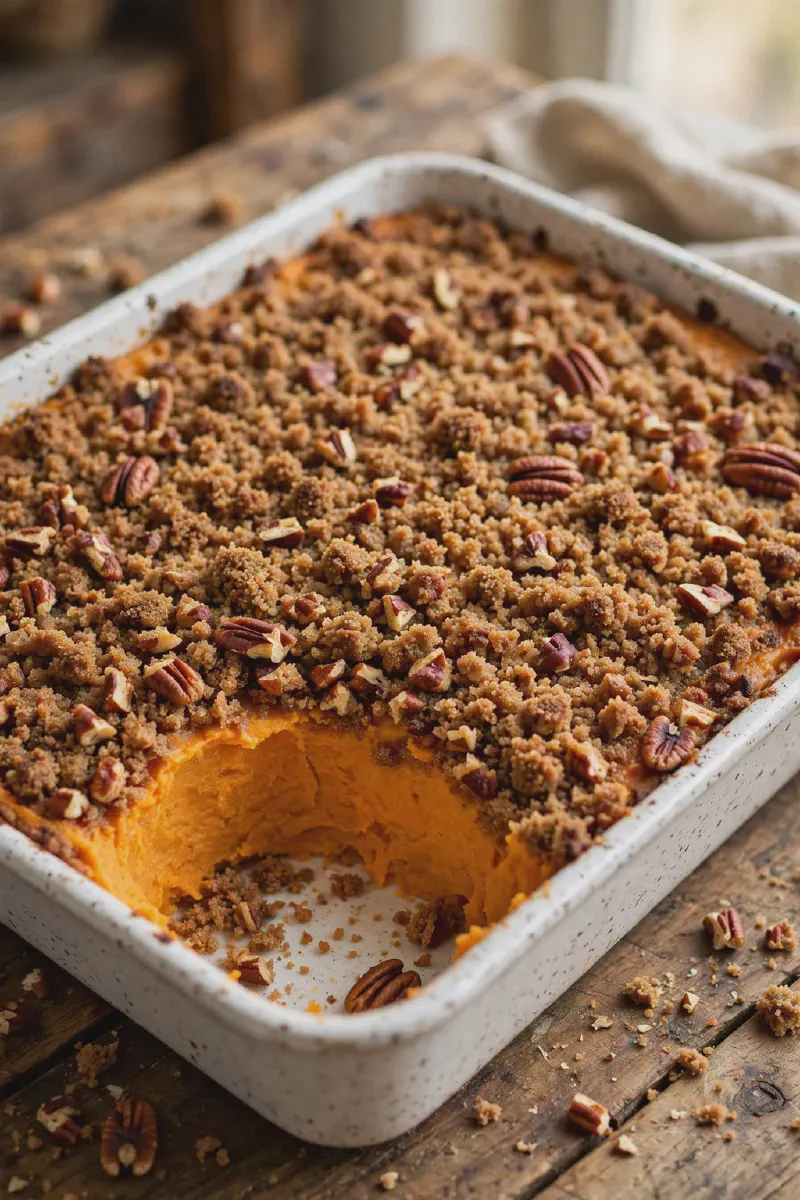
Sweet potatoes carry most of this dish. Four cups of them, boiled until tender and mashed while hot, get beaten smooth with eggs, milk, butter, and half a cup of sugar, then spread in a 9x13-inch dish. The topping is where the texture changes: brown sugar, flour, and butter cut together roughly, chopped pecans folded in at the end, scattered over the top so it bakes into coarse, crisp crumbs instead of a paste. The oven is 325°F (163°C) and the whole thing takes about an hour from start to finish.
The hour breaks down honestly. Prep is 15 minutes: peeling and cubing the potatoes, measuring, and mixing. Cook time is 45 minutes, and it covers two separate jobs, 10 to 15 minutes boiling the potatoes until a fork slides in, then about 30 minutes in the oven once the dish is assembled. Nothing sits around resting or chilling in between, so 15 plus 45 is the full 60. Two variables can stretch it: cubes cut large or uneven take the long end of the boil, and a casserole assembled from cold, made ahead filling can need a few extra minutes in the oven. Both are covered below.
Getting the filling smooth without making it gluey
Sweet potatoes mash best hot and right after draining. Let them sit in the colander and they cool, firm up, and start to lump; mash them straight away with a fork while they are still steaming and they break down with almost no effort. A fork is enough here. There is no need for a mixer, and a food processor is the one tool to avoid, because it can turn the mash stringy and gluey instead of smooth.
The order in the recipe card is deliberate. The beaten eggs go in first, while the mash is hot, and get mixed until combined, so they disperse evenly instead of sitting on top. Then the sugar, milk, softened butter, vanilla, and salt go in together. Softened butter matters more than it sounds: cold butter added to hot mash melts in patches and can leave greasy streaks, while softened butter blends straight in. The finished filling should look like a thick, pourable mash, closer to mashed potatoes than to cake batter. If it looks stiff, the potatoes were on the dry side; a splash of milk, a tablespoon at a time, brings it back. Spread it level in the dish so the topping sits evenly and the centre and corners bake at the same rate.
One quantity note: 4 cups of cubed sweet potatoes is about 2 1/2 lbs of whole potatoes before peeling. Buy a little over rather than a little under; a filling that comes up short leaves the dish thin and lets the topping take over.
The topping: coarse crumbs, not cookie dough
The topping is brown sugar and flour with butter cut in, and the instruction that decides how it turns out is the one in the card: cut the butter in with a pastry cutter to coarse crumbs, and do not overmix. The goal is a loose, sandy mixture with visible small pieces of butter still in it. Those pieces melt in the oven and leave the crumbs crisp and separate. Work the mixture too long, especially with warm hands, and the butter disappears into the flour and sugar; the topping then bakes as a single sweet sheet, chewy in the middle instead of crisp.
The butter for the topping is softened, same as the filling, which makes it easy to work too far. Stop earlier than you think you should. If the crumbs start clumping into dough, put the bowl in the fridge for 10 minutes and finish with a fork. Stir the pecans in last, after the crumbs are formed, so they stay in distinct pieces instead of getting ground into the mixture. Sprinkle everything edge to edge. Bare patches of filling puff up and dry out in the oven, while covered patches stay moist, so an even layer is also how you get an even bake.
Chop the pecans to roughly pea size. Much larger and they sit on top like a garnish and fall off when you scoop; much smaller and they vanish into the crumbs and you lose the contrast that is the point of the topping.
The bake at 325°F
This casserole bakes at 325°F (163°C), lower than most sides, and the lower heat suits it. The filling is already cooked before it goes in. The oven’s jobs are to set the eggs so the filling holds a scoop, heat everything through, and brown the topping without scorching its sugar. At a higher heat the brown sugar at the edges can darken past pleasant before the centre sets; at 325°F the topping comes out lightly browned in about 30 minutes, which is the cue to take it out.
Dish material moves the timing a little. A glass or ceramic 9x13 holds heat and bakes gently; a dark metal pan runs hotter at the edges and can finish a few minutes sooner, with darker crumbs around the rim. Cubes that boiled the full 15 minutes also give a softer filling that sets faster than a batch pulled at 10 minutes while still firm. Check at 25 minutes the first time you make it in a new dish: the topping should be lightly browned and the filling should hold still when the dish is nudged, not ripple.
On a holiday table this sits comfortably next to other oven and slow cooker sides, because it asks for so little attention once it is in. The slow cooker sausage, apple and sage stuffing frees up the stove entirely, and creamy stovetop mac and cheese covers the rich, savoury end of the table while the casserole handles the sweet one.
Making it ahead, storing it, reheating it
The filling and the topping can each be prepped 1 to 2 days ahead, and they should wait separately. Spread the filling in the 9x13 dish, cover it, and refrigerate it. Keep the topping in its own covered container in the fridge too. Kept apart, the crumbs stay dry; combined a day early, they pull moisture out of the filling overnight and bake up soft. At serving time, sprinkle the cold topping over the cold filling and bake as written, allowing a few extra minutes for a chilled casserole to heat through and set.
Leftovers keep 3 to 4 days in the fridge, covered in the dish or moved to a container. To reheat, cover with foil and warm at 350°F (177°C) for 20 to 25 minutes. The foil is doing specific work: it traps steam so the filling reheats without drying, at the cost of softening the topping a little. If a crisper top matters more than moist edges, take the foil off for the last 5 minutes.
Questions that come up
Can I leave the pecans out? Yes. Make the topping exactly as written and simply skip the pecans; the brown sugar crumb still browns and crisps. The casserole also loses its crunch contrast, so serve it promptly, while the plain crumb is at its crispest.
Can I halve the recipe? Yes, in an 8x8-inch or similar 2-quart dish. Use half of every ingredient, keep the oven at 325°F (163°C), and start checking the bake at 20 to 25 minutes, since a shallower dish sets faster than the full 9x13.
Why is there no cinnamon in the filling? Because this version seasons with vanilla and salt only, and the sweet potatoes carry the flavour. The result tastes like sweet potato first, which is also why the sugar stays at 1/2 cup. Adding cinnamon changes the dish into something else; it is a variation, not a correction.
Can I use canned sweet potatoes? Fresh gives the cleanest flavour and the right texture, but drained canned sweet potatoes work in a pinch. Use the same 4 cups, drained well and mashed, and expect a softer, sweeter filling; hold back a tablespoon or two of the milk if the mash already looks loose.
What brings some heat to the table? Maple sriracha cauliflower is the spicy counterpoint: same meal, opposite direction, and it roasts at a higher heat while the casserole rests.