The Story
The short answer
Use the air fryer for leftovers that were crisp, roasted, or breaded to begin with. Set it to 350 to 375°F, lay the food in one layer with space around each piece, and give most foods three to eight minutes. Turn or shake the food once. Check that the centre is steaming hot before you eat, and aim for 165°F for meat, poultry, and mixed dishes. Send soups, stews, and loose sauces to the stove or the microwave instead.
Leftovers fail in the microwave in a very specific way. The heat is fast, but it leaves crusts soft, fries limp, and chicken skin rubbery. The air fryer fixes that one problem because it moves dry hot air around the food. It brings back the crisp edges you liked on the first night, as long as you pick the right foods and give the air room to work.
Why this works for some foods and not for others
Why it matters: an air fryer reheats from the outside in with dry heat. Foods with a crust, a coating, or roasted edges love that. The surface dries and crisps while the inside warms through. Foods that are mostly liquid have nothing to crisp, and the moving air can dry the top while the centre stays cool.
What to do instead: match the tool to the food. Use the air fryer for pizza, fries, roasted vegetables, breaded chicken, and baked potatoes. Use a covered dish in the air fryer for a pasta bake or a small portion of casserole. Use the stove for soup and stew, where you can stir and heat the whole pot evenly.
The basic method
Start with a short warm up. Run the empty basket at your reheating temperature for about three minutes. Food that lands in a hot basket starts to crisp at once instead of steaming while the machine warms up.
Lay the food in one layer. Leave a small gap between pieces so air can reach the sides and the bottom. If you have a lot of food, reheat it in two small batches. The second batch goes faster in a hot basket, and both batches stay crisp.
Use moderate heat. Most leftovers do best at 350 to 375°F. Very high heat browns the outside before a thick piece warms through. Lower heat suits thick slices and dense dishes, because it gives the centre time to catch up.
Turn or shake once. Flip pizza, chicken pieces, and cutlets with tongs about halfway through. Shake fries and vegetables so the pale pieces move to the top.
Check the centre, not just the surface. Cut into the thickest piece or stir a dish in a heat safe dish and check again. Leftovers should be steaming hot all the way through. A food thermometer removes the guesswork. Aim for 165°F.
Eat it promptly. Reheat only what you plan to eat, and reheat leftovers once. Put food back in the fridge within two hours after the first cook, and eat most cooked leftovers within three to four days.
Foods that reheat beautifully
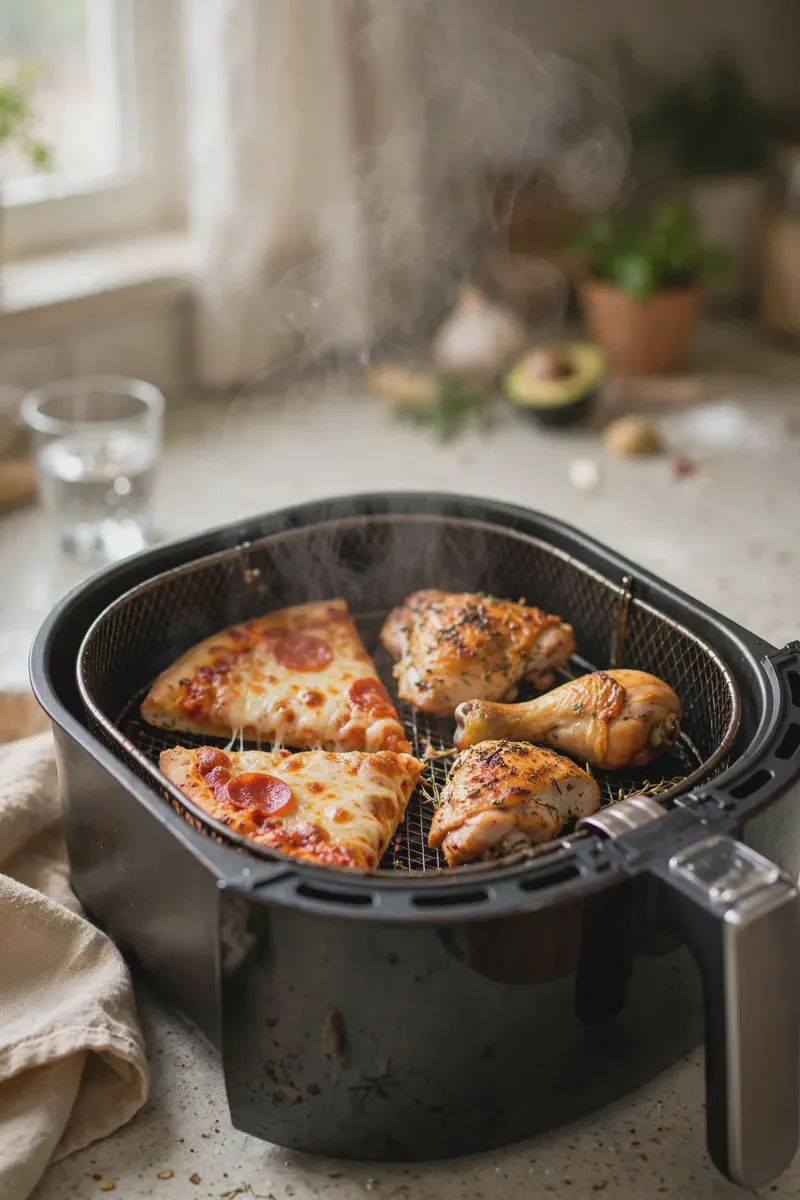
Pizza is the clear winner. A slice comes back with a crisp base and melted cheese in a few minutes, where the microwave leaves the base soft and chewy.
Fries and wedges also come back well. They need high heat for a short time and a shake halfway through. They will not taste fresh from the fryer, but they will be hot and crisp instead of limp.
Breaded chicken, roasted chicken pieces, and cutlets hold up well because the coating protects the meat while it warms. Turn them once and watch thick pieces closely, because the outside can darken before the centre is hot.
Roasted vegetables, baked potatoes, and roasted potatoes reheat with their edges intact. Give them space and check them early, since small pieces warm faster than you expect.
Foods to send elsewhere
Soup, stew, and curry belong on the stove. You can stir them, the heat spreads through the liquid, and nothing dries out on top.
Plain rice and plain pasta dry out fast in moving hot air. A splash of water and a covered dish in the microwave, or a pan on the stove with a lid, keeps them soft.
Soft scrambled eggs, leafy salads, and dishes built around fresh herbs lose their texture in the basket. Eat those cold, warm them gently in a pan, or save the fresh parts and add them after the rest of the food is hot.
Very saucy dishes can work in the air fryer only when they sit in a heat safe dish that fits the basket with room around it. Stir once partway through so the centre heats as well as the edges.
Quick reference
| Food | Temperature | Time to start with | Notes |
|---|---|---|---|
| Pizza, regular slice | 350°F | 3 to 5 minutes | One layer; check at 3 minutes |
| Pizza, thick slice | 325°F | 4 to 6 minutes | Lower heat lets the centre warm |
| Fries and wedges | 375°F | 3 to 5 minutes | Shake once halfway through |
| Breaded chicken and cutlets | 375°F | 5 to 8 minutes | Turn once; check the thickest part |
| Roasted chicken pieces | 350°F | 6 to 10 minutes | Rest a minute before serving |
| Roasted vegetables | 375°F | 3 to 5 minutes | Small pieces warm fastest |
| Baked potato | 375°F | 8 to 10 minutes | Cut in half for a faster reheat |
| Pasta bake in a dish | 325°F | 8 to 12 minutes | Stir or check the centre once |
The rule is simple. If the food was better with a crisp edge on the first night, give it a few minutes in the air fryer at moderate heat, in one layer, with one turn. If the food was soft, wet, or built to be spooned, warm it where you can stir it. Do that and leftovers stop tasting like a compromise and start tasting like a second good meal.